



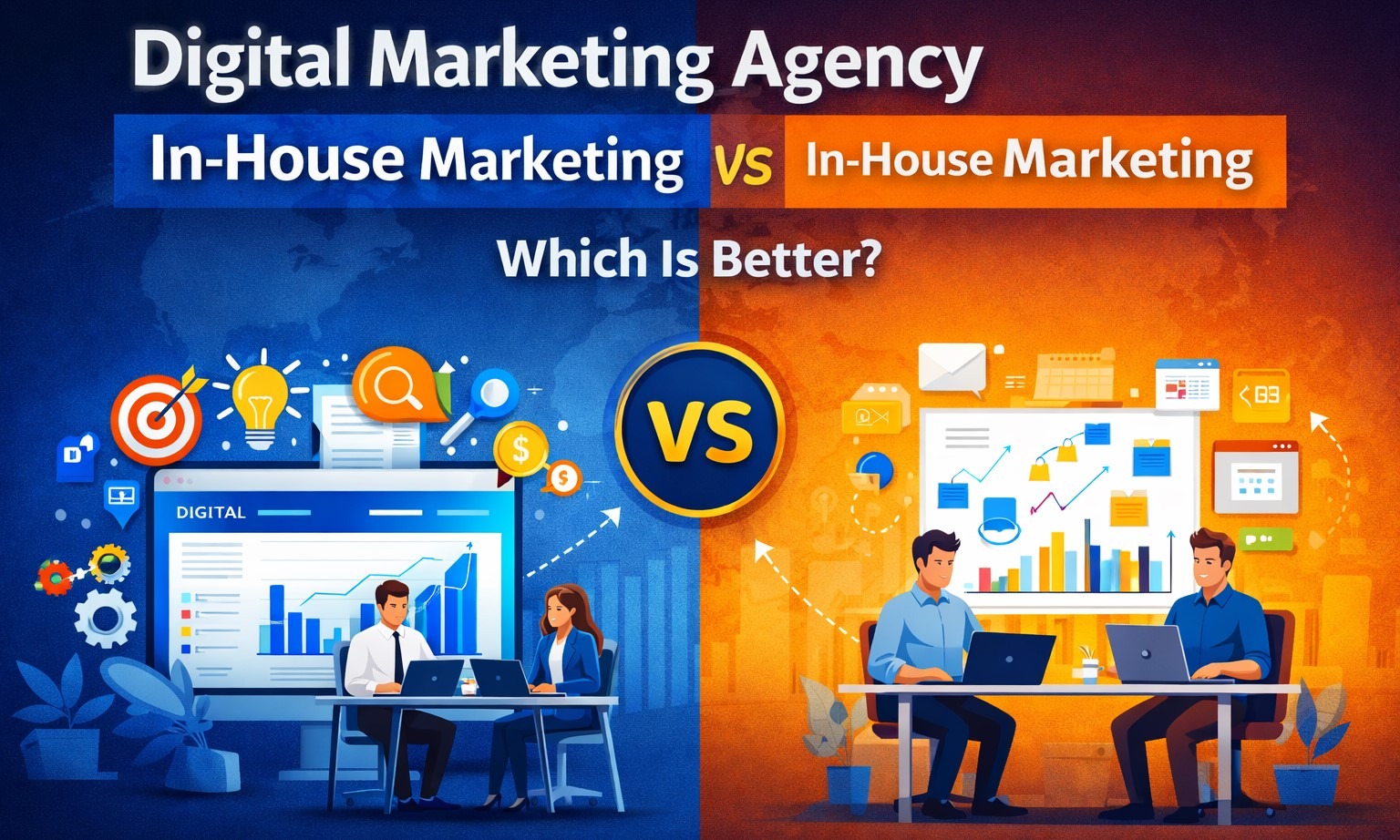




Few strategic choices have as much downstream impact on a growing business as the one between hiring a digital marketing agency and building an internal team. Get it right, and your marketing function becomes a compounding growth engine. Get it wrong, and you spend eighteen months unwinding a structure that never fit your needs in the first place — at significant cost in money, time, and momentum.
The frustrating truth is that most of the content on this subject is written by agencies (who naturally favour the agency model) or by HR platforms (who naturally favour headcount growth). Neither perspective is particularly objective. This article takes a different approach. It talks about the real trade-offs on both sides, such as the structural benefits, the hidden costs, the situations in which each model works best, and the hybrid arrangements that the smartest businesses are using to get the best of both worlds.
No matter what you’re doing right now—deciding whether to hire your first marketer, rethinking an agency contract that hasn’t lived up to its promises, or just trying to plan the next year of growth—this comparison will help you make the right choice without having to guess.
1: The Real Cost of Each Model — Beyond the Obvious Numbers
The most common mistake in this comparison is looking only at the invoice. A monthly retainer for a top digital marketing agency looks expensive until you calculate the fully-loaded cost of an equivalent internal team — salaries, benefits, recruitment fees, onboarding time, software subscriptions, training budgets, and management overhead. When those numbers are placed side by side honestly, the agency model frequently wins on pure cost efficiency at every level below a certain scale.
What In-House Teams Actually Cost
In India, hiring a good in-house marketing manager costs between ₹8 and ₹20 lakhs per year, depending on their experience and where they live. That gets you one person with a certain set of skills. If you wanted to do what a full-service digital marketing agency in India does—SEO, content, paid media, social media, analytics, and strategy—you would need at least four to six specialists, each with their own salary range, as well as the tools that each discipline needs. For most companies that don’t make a lot of money, that number of employees just doesn’t make sense.
What Agencies Actually Cost — And What That Includes
An affordable digital marketing agency operating on a mid-market retainer is not just billing for hours. Embedded in that monthly fee is access to an entire technology stack — analytics platforms, SEO tools, creative software, audience intelligence systems, and reporting infrastructure — that would cost considerably more to assemble independently. It also includes the institutional knowledge the agency has built across dozens of client relationships: pattern recognition that no newly hired internal team member can arrive with on day one.
2: Where a Digital Marketing Agency Holds a Structural Advantage
There are specific growth scenarios where a digital marketing agency does not just match an in-house team — it fundamentally outperforms one. Understanding these scenarios prevents businesses from building internal structures that were never suited to the challenge they face.
Multi-Channel Expertise Without Multi-Channel Headcount
A credible best digital marketing agency employs specialists across every major channel under one roof.A single account director makes sure that the SEO strategist, the paid search manager, the content lead, and the analytics engineer all work together on your account instead of separately. To get that kind of coordination to work inside the company, you need more than just individual hires. You also need a management layer that can bring together work from different channels, which is a big investment for the company..
Speed to Market and Strategic Agility
Markets move fast. Platform algorithms shift. Consumer behaviour pivots. A creative digital marketing agency with enough resources can quickly adjust to these changes by moving work around between channels, trying out new formats, or changing its strategy in a single sprint cycle. Internal teams tend to move more slowly because they have to follow certain rules and have a limited number of people. A business with an agile agency partner is better able to respond quickly when a competitor starts a new campaign or a platform gets a big feature update.
Access to a Living Knowledge Base
Every Digital Marketing Expert inside a well-run agency is simultaneously working across multiple client accounts, industries, and growth challenges. This cross-pollination of experience is genuinely difficult to replicate in-house. When your agency’s paid media team solves a campaign efficiency problem for a retail client on Tuesday, the insight from that solution is available to your account on Wednesday. Internal teams accumulate knowledge about one business. Agency teams accumulate knowledge about many — and that breadth of experience has tangible strategic value.
3: Where In-House Teams Hold Their Ground
The agency model is not without its limitations. There are situations where an internal team will consistently outperform an external partner, and being honest about those scenarios matters as much as celebrating agency advantages.
Deep Brand and Cultural Immersion
No agency, no matter how thorough its onboarding process is, will ever know your brand as well as someone who has worked there for two years. Marketers who work for the company go to product meetings, listen to customer calls, and sit in on sales debriefs. They take in information that doesn’t always make it into a short document. For brands where tone, nuance, and cultural alignment are very important—like luxury goods, mission-driven businesses, and highly regulated categories—this immersion is really useful for strategy in a way that an outside team can’t fully copy.
Sustained Reactive Content and Real-Time Engagement
Social media moments do not wait for agency approval cycles. When a brand needs to respond to a trending conversation, publish a reactive piece of content, or manage a fast-moving community issue, an internal team has a structural speed advantage. A best digital marketing agency in India handling twelve simultaneous client accounts simply cannot provide the level of real-time responsiveness that a dedicated in-house social media manager can — and for brands where social presence is a primary growth driver, that responsiveness matters.
4: The Specialist Agency Model — A Middle Path Worth Considering
The binary framing of ‘agency versus in-house’ obscures a third model that many sophisticated brands are quietly gravitating toward: a lean internal strategy function supported by specialist external agencies for execution. Rather than one generalist partner handling everything, this approach routes specific disciplines to the agencies most qualified to handle them.
How Specialist Agencies Add Targeted Value
A SEO Services Agency In India with deep organic search expertise will consistently outperform the SEO output of a generalist agency that treats it as one of twelve services. Similarly, a dedicated Content Marketing Agency In India with an editorial team and established distribution network will produce higher-quality, better-performing content than an all-in-one shop managing content as a line item. The trade-off is coordination complexity — more agency relationships to manage — but for businesses at the right scale, the performance uplift more than justifies the overhead.
The Hybrid Model in Practice
The best hybrid setups have an internal marketing lead or the best digital marketing agency near me in charge of overall strategy, brand governance, and cross-channel coordination. Then, specialist agencies handle the details at the channel level. This keeps the brand immersion and institutional knowledge of an internal function while also getting the technical depth and channel-specific knowledge that only dedicated specialists can offer.. It is not the simplest model to manage, but it tends to produce the best outcomes at mid-to-large growth stages.
5: How to Make the Right Call for Your Business Right Now
The correct answer to ‘agency or in-house?’ is almost always ‘it depends’ — but that answer is only useful if you know what it depends on. Here are the specific variables that should drive the decision, applied to your current situation.
Your Current Revenue and Growth Stage
Below a certain revenue threshold — generally speaking, before a business is generating enough to justify significant fixed headcount — the agency model offers better value, faster results, and lower risk. A digital marketing near me search may surface affordable options that are more than capable of driving the growth needed to reach the next stage. As revenue scales and marketing complexity increases, the argument for internal capability grows proportionally stronger.
The Channels That Drive Your Growth
If your business grows primarily through organic search and content, the question is whether a top digital marketing agency with strong SEO and content credentials can serve you better than an in-house hire who owns those channels end to end. If growth is paid-media-led, the same logic applies to performance marketing. Map your primary and secondary growth channels first — then evaluate which model provides the deepest capability in exactly those areas.
Your Capacity to Manage the Relationship
Agencies do not run themselves. The best agency relationships require a capable internal point of contact who can brief well, give feedback clearly, make decisions efficiently, and hold the agency accountable to agreed outcomes. Businesses that lack this internal capability often blame agencies for underperformance that is actually a consequence of poor briefing and slow approval cycles. Before hiring any best digital marketing agency, honestly assess whether your organisation is set up to be a good client — because that determines the outcome as much as the agency’s capabilities do.
Read More: https://worldsschedule.com/
Conclusion: The Answer Is in the Evidence, Not the Instinct
Neither the agency model nor the in-house model is universally superior.Each one is the right answer for a certain type of business, at a certain stage of growth, and in certain situations. Companies that make good decisions about this question all the time are the ones that think about it analytically. They look at their real needs, their real limits, and their real choices instead of just going with the model that seems most familiar or comfortable.
Each is the right answer in specific circumstances, for specific business types, at specific growth stages. The businesses that make consistently good decisions about this question are the ones that approach it analytically — mapping their actual needs, their genuine constraints, and their realistic options — rather than defaulting to whichever model feels most familiar or most comfortable.
When you are looking for a digital marketing agency to work with, make sure they meet the same standards as an internal hire: they should be able to think clearly, show you results, communicate honestly, and be able to show you that what they do well is what your business really needs. That alignment — not the model — is what drives growth.
